An Arizona family won a $435,000 judgment in federal court after a child swallowed a decorative bead coated with a chemical that metabolized into a date-rape drug when ingested, marking the first verdict of its kind in the nation over the toy. The toy was made in China. Read more
Tag Archive for: Consumer Products
Aug. 14, 2008
From lunchboxes and backpacks to baby cribs and toy figurines, a lengthy effort to make children’s products safer has finally cleared the final hurdles. New toy safety standards become law. Read more
KENTWOOD, Mich. (WZZM) – A toothbrush company that outsourced some of its manufacturing to China years ago is bringing work back to West Michigan. Read more

In a recent study conducted by Consumer Reports, more than 60 percent of people interviewed claimed they would gladly shell out more money for American made products—even if those products cost an average of 10 percent more than products sourced internationally. Read more
Tyson Foods will no longer use human antibiotics in chickens. The Arkansas-based company, the nation’s largest seller of chicken, is announcing today that it plans to eliminate the use of medically important antibiotics in its flocks by September 2017. Read more
Shopping for shrimp is confusing. Packages can have so many labels that it’s hard to know which ones to trust. One way to separate the best from the rest is to buy sustainably farmed or responsibly caught. We believe that your best choice is wild shrimp, especially those that have been responsibly caught in the U.S. Read more
In congressional testimony Thursday, the National Pork Producers Council said the United States must address its mandatory Country-of-Origin Labeling (COOL) law to avoid trade retaliation from Canada and Mexico.
At first the (slaves) men filtered in by twos and threes, hearing whispers of a possible rescue. Read more

The World Trade Organization (WTO) has ruled in favor of Canada and Mexico in an ongoing dispute with the United States over country-of-origin labeling (COOL) on meat. Read more

You’ve probably seen, but may not have noticed, labels on the meat at your grocery store that say something like “Born, Raised, & Harvested in the U.S.A.” or “Born and Raised in Canada, Slaughtered in the U.S.”
Read moreThe U.S. economy is facing a predicament the Federal Reserve didn’t anticipate — a stronger than expected U.S. dollar. Investors are encouraged to Buy American. Read more
For all expecting and new parents, you probably have learned how quickly buying your child’s products adds up! So why would you be willing to pay more for an American-made product when you could purchase a similar product or even the “same” product, produced overseas, for half the cost? Read more
Nine Australians have contracted hepatitis A linked with eating contaminated berries from China, with the importer apologizing Tuesday as the food scare spreads. Read more

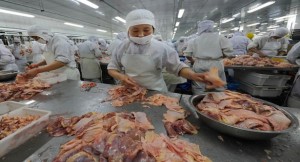
Yet again another food scandal is among us as the U.S. Department of Agriculture recently agreed to allow four chicken processing plants in China to raise and slaughter their chickens in the U.S., export them to China for processing, and them ship them back to the U.S. These chickens will then be sold on every grocery store shelf in the United States with no country of origin labeling. What’s worse is that U.S. inspectors will not be on site at the processing plants in China before the processed chicken will be shipped to the U.S. Again, chicken from China labeled “Made In America”?
Read more
Last week, Walmart expanded on the $50 billion Buy American pledge it made last January with a full-fledged Made-in-America summit.

Chris Rank | Bloomberg | Getty Images
A curious thing is happening among American shoppers. More people are taking a moment to flip over an item or fish for a label and ask, is it “Made in the USA?” Walmart, the nation’s largest retailer, earlier this year announced it will boost sourcing of U.S. products by $50 billion during the next 10 years. General Electric is investing $1 billion through 2014 to revitalize its U.S. appliances business and create more than 1,500 U.S. jobs.
Mom-and-pops are also engineering entire business strategies devoted to locally made goods — everything from toys to housewares. And it’s not simply patriotism and desire for perceived safer products which are altering shopping habits.
The recession, and still flat recovery for many Americans, have created a painful realization. All those cheap goods made in China and elsewhere come at a price — lost U.S. manufacturing jobs. A growing pocket of consumers, in fact, are connecting the economic dots between their shopping carts — brimming with foreign-made stuff — and America’s future.
They’re calculating the trade-offs of paying a little more for locally-made goods.”The Great Recession certainly brought that home, and highlighted the fact that so many jobs have been lost,” said James Cerruti, senior partner for strategy and research at consulting firm Brandlogic. “People have become aware of that.”
‘Made in the USA’ is known for one thing, quality,” said Robert von Goeben, co-founder of California-based Green Toys. All of their products from teething toys to blocks are made domestically and shipped to 75 countries.
“We are reaching a tipping point, where Americans are relearning its competitive advantage,” von Goeben said. “It’s not about the cheapest product, but the best quality product.”
For many consumers, affordability has driven the bulk of purchasing decisions. Businesses in turn have ventured abroad for cheap labor and specific manufacturing skills to keep prices down.
So what’s driving big and small businesses to increase sourcing of U.S. products — beyond the obvious good PR?
In short, a shift in global manufacturing that’s in the early stages. A combination of factors including rising labor costs are eroding China’s cost advantage as an export platform for North America.
Mexico, meanwhile, is rebounding as a manufacturing base, and wages there will be significantly lower than in China, according to a Boston Consulting Group report. By 2015, BCG forecasts that for many goods destined for North American consumers — manufacturing in some parts of the U.S. will be just as economical as manufacturing in China.
For years, the main attraction of China outsourcing has been access to low-cost labor. But pile on related business costs such as transportation of goods, duties and industrial real-estate expenses, and the global manufacturing landscape is no longer China-dependent.
Domestic manufacturing, meanwhile, is on the mend. The pace of growth in the U.S. manufacturing sector picked up to its fastest rate in more than a year and a half in February, as new orders continued to accelerate.
And imported goods — at least in footwear and apparel — are retreating slightly. While more than 97 percent of apparel and 98 percent of shoes sold in the U.S. are made overseas, U.S. imports in those two categories in 2011 declined for the first time ever since such data has been tracked by the American Apparel & Footwear Association.
“The cost competitiveness of U.S. manufacturing is on the rise,” said Cerruti of Brandlogic.
Of course, plenty of goods are still made abroad. And many Americans are broke, jobless or underemployed four years after the 2008 economic crisis. An unemployment measure that factors in those who have quit looking for jobs, as well as those working part-time for economic reasons, is at 14.4 percent. For many, buying “Made in the USA” is a luxury they can’t afford.

Sarah Wagner was inspired by a road trip including tours of US companies to create USA Love List, a website devoted to American-made goods.
USA Love List[p][/p]
Despite many shoppers’ thin wallets, there’s a growing appetite for domestically-made goods.
Blogger Sarah Wagner has turned her passion for “Made in USA” products into a successful website. USA Love List is devoted to sourcing and showcasing where to buy domestically-made items, ranging from lip gloss to pet food. She regularly scans the aisles of big retailers such as Costco and Target for American-made goods.
Site traffic has mushroomed since USA Love List launched in November 2011. “There’s clearly a hunger for this sort of information,” said Wagner, based in Philadelphia. “Companies have no idea how much Americans want to support American companies. They want to get behind their neighbors and communities to make sure those jobs stay there. It’s struck a nerve with a lot of people,” she said.
American-Made Green Products
Among the growing piles of American-made goods, many are green with recycled materials. Turns out it’s easier to manufacture green products domestically because sourcing of recycled materials including recycled plastic is particularly plentiful and transparent in the U.S., said Jenna Sellers Miller, president of Architec Housewares, a 9-employee housewares business, based in Delray Beach, Fl.
Some of Architec’s EcoSmart line of products are sourced domestically. The products are available at Target, Macy’s and Bed Bath & Beyond. “We’re getting appointments with retailers who just want to see our ‘Made in the USA’ products,” Miller said.
Domestically sourced recycled materials and a broader commitment to the environment shape Green Toys business strategy as well. With their factory and warehouse 10 miles apart in northern California, they also cut transportation costs and related emissions.
The 12-employee company also creates a ripple effect of jobs including supporting local drivers, shipping and packaging companies and testing labs. “We could not have started this company anywhere else,” von Goeben said. “This is a uniquely American company.”
Later this year, Green Toys will ship its first batch of toys from northern California to China. Said von Goeben, “It’s the irony of all ironies.”
SOURCE: CNBC

Walmart today announced bold commitments to increase domestic sourcing of the products it sells and help veterans find jobs when they come off active duty. Speaking at the National Retail Federation’s annual BIG Show, Walmart U.S. President and CEO Bill Simon also announced the company is helping part-time associates who want to be full time, make that transition.
Probably more than you think. As more manufacturing returns to U.S. shores, early signs show that a “Made in America” label is a serious competitive advantage.

All American Clothing Co., proud corporate members of The Made in America Movement, announces a new warning label that raises awareness of the consequences of outsourcing and buying foreign-made items in the United States. Read more