Behind the Label: How the FTC’s ‘Made in USA’ Crackdown Is Reshaping Trust in American Brands

A few months ago, while searching for a birthday gift for a friend, I thought I’d struck gold with a coffee mug stamped “Made in USA.” Imagine my embarrassment when, after some digging (and a slightly suspicious price tag), I discovered it was Made in China.

Turns out, I’m far from alone: the Federal Trade Commission (FTC) is getting tough on companies faking their “Made in USA” claims, disrupting not just shoppers’ trust but the entire marketplace. Let’s dig into why this crackdown is a big deal for brands and buyers, and how you (and I) can avoid being duped again.

TL;DR: The FTC’s push for honest ‘Made in USA’ labeling means bigger consequences for cheats—and more chances for authentic American brands to shine. Seek out transparency, ask questions, and support the makers who truly keep it local. Read more

Kubota Slapped With Historic Penalty for False 'Made in USA' Claims

In recent times, Kubota North America Corporation, a prominent player in the tractor and heavy equipment manufacturing industry, has been handed a hefty $2 million civil penalty by the Department of Justice. This penalty, the result of a legal wrangle involving allegations of misrepresenting the origins of replacement parts, has been dictated by the Federal Trade Commission (FTC).

The FTC claims that Kubota has breached the Made in USA labeling rule, asserting that the company failed to amend product labels to denote the true origins of parts accurately. This instance is not the first of its kind, as it echoes a similar violation by a Kubota subsidiary in 1999.

It’s critical to note that Kubota is displaying an active commitment to resolving these issues, cooperating fully with the U.S. government and putting into place improved labeling accuracy measures. Such an unprecedented case brings into question the broader implications for other manufacturers and the enforcement of the Made in USA Labeling Rule.

Read more

Buy American Made: Ways to Express Your Values With Your Pocket Book

In today’s global market, where products are manufactured has become a significant consideration for consumers. Many individuals seek to align their purchasing choices with their personal values, particularly by buying American-made products.

This article explores the importance of buying American-made goods and provides strategies for identifying truly American products in a market that can sometimes be misleading.

By making informed decisions and supporting local businesses, consumers have the potential to positively impact both the economy and society as a whole.

Key Takeaways

  • Purchasing American-made products allows individuals to align their spending with their values.
  • Buying American-made products can support local communities and small businesses.
  • Labels such as USDA Organic and Made in USA Certified help consumers make environmentally conscious choices.
  • Identifying truly American products can be challenging, so buyers should do their own research and remain cautious.

The Power of Purchasing: How Buying American-Made Products Reflects Your Values

Purchasing American-made products allows consumers to align their values with their spending choices, reflecting their commitment to supporting local businesses and ethical manufacturing practices. When consumers choose to buy American-made products, they are not only supporting the local economy, but also promoting fair labor practices and sustainable sourcing of materials.

Ethically sourced materials play a significant role in the production of American-made products, ensuring that the supply chain is transparent and free from exploitation.

Additionally, consumer education plays a crucial role in promoting the purchase of American-made products. By educating consumers about the benefits of buying American-made, they can make informed decisions and actively contribute to a more sustainable and ethical economy.

Ultimately, purchasing American-made products empowers consumers to make a positive impact by supporting local businesses and promoting ethical manufacturing practices.

Supporting Local Agriculture: Ethical Food Choices That Align With Your Pocket Book

Supporting local agriculture and making ethical food choices allows consumers to contribute to their community and promote sustainable farming practices. By purchasing locally grown or raised products, consumers support local farmers and reduce the distance between producers and consumers. This not only helps to strengthen the local economy but also allows consumers to have a direct impact on the quality and safety of their food.

Additionally, choosing food labels such as USDA Organic, free range, hormone-free, and grass-fed helps consumers make environmentally conscious choices. These labels indicate that the food has been produced using sustainable farming methods and supports the well-being of animals.

Finding Authentic American-Made Products: Tips and Resources to Guide Your Purchasing Decisions

One way to ensure the authenticity of American-made products is by checking for specific labels or certifications that indicate their origin. These labels serve as reliable resources for consumers who want to make informed purchasing decisions.

The ‘Made in the USA’ label, regulated by the Federal Trade Commission (FTC), is an important indicator of a product’s origin. However, it is essential for buyers to remain cautious and do their own research, as some companies may misuse this label. The FTC also receives complaints about mislabeled products, but investigations and penalties are limited.

To find authentic American-made products, consumers can rely on resources such as the National Center for Employee Ownership, which provides a list of companies owned by their employees. Additionally, regional and national firms are the main source of American-made products, and their status can be easily checked.

Assessing the American Content: Understanding the Criteria for Identifying Truly American Products

The American Automobile Labeling Act (AALA) requires automobiles and trucks to display the percentage of domestically produced content. This act aims to provide consumers with information about the origin of the components used in their vehicles.

To further assess the American content of vehicles, the Kogod Made in America Auto Index incorporates the AALA and adds additional criteria. This index allows consumers to compare the American content of different vehicles and make informed purchasing decisions.

However, outside of automobiles, textiles, and furs, there is no specific identification of product origin or components required. This poses challenges in identifying truly American products, as companies can claim a product is ‘Made in the USA’ as long as it has negligible foreign content and final assembly or processing in the U.S.

Buyers should therefore remain cautious and do their own research when relying on the ‘Made in the USA’ label.

Overall, the AALA and the Kogod American Content Index provide valuable tools for assessing the American content of products and making informed purchasing decisions.

Navigating Challenges: Ensuring Your Purchases Reflect Your Values Amidst Misleading Claims

Amidst misleading claims, it is crucial to carefully navigate the challenges of ensuring that your purchases truly align with your values.

While the Federal Trade Commission (FTC) regulates the ‘Made in the USA’ label, investigations and penalties are limited. The FTC often receives complaints from manufacturing competitors, but settlements with no civil penalties are common.

However, California has stricter regulations and higher penalties for misusing the ‘Made in the USA’ label. Buyers should remain cautious and do their own research when relying on the label.

It is important to be aware of FTC regulations and the potential penalties in California to avoid falling victim to misleading claims. By understanding these regulations and penalties, consumers can make informed decisions and ensure that their purchases reflect their values.

Frequently Asked Questions

How Can Buying American-Made Products Reflect Your Values?

Buying American-made products allows individuals to support their local economy and preserve American jobs. By making conscious purchasing choices, consumers align their values with their pocketbooks, contributing to the well-being of their community and the nation.

What Are Some Resources to Help You Find Authentic American-Made Products?

Online directories and local craft fairs are valuable resources for finding authentic American-made products. These platforms provide access to a wide range of products, allowing consumers to support local businesses and make informed purchasing decisions.

What Criteria Are Used to Assess the American Content of Vehicles?

Assessment criteria are used to evaluate the American content of vehicles, including the American Automobile Labeling Act and the Kogod Made in America Auto Index. Manufacturing regulations require companies to accurately label products as "Made in the USA."

How Does the Federal Trade Commission Regulate the "Made in the Usa" Label?

The Federal Trade Commission regulates the ‘Made in the USA’ label, ensuring that companies claiming this designation meet certain criteria, such as negligible foreign content and final assembly or processing in the U.S. However, investigations and penalties are limited, and buyers should exercise caution when relying on this label.

What Challenges Do Consumers Face in Identifying Truly American Products?

Identifying American products can pose challenges for consumers. The Federal Trade Commission regulates the "Made in the USA" label, but investigations and penalties are limited. Consumers should remain cautious and do their own research to ensure product origin.

Know The Difference Between Made in USA and Assembled in USA

Made in USA. Three little words with a not-so-little impact! Read more

Made in USA? Tips for Finding Certified American Products

As it turns out, a flag label doesn’t guarantee that a product was born in the “land of the free and the home of the brave.” A recent Consumer Reports survey found that 8 out of 10 consumers would rather buy a domestically made product than an imported one, but it’s difficult to figure out which are the frauds. Read more

The Not So COOL Reason You Won’t Know Where Your Steak Came From

Cases of bovine spongiform encephalopathy—mad cow disease—have been reported in Brazil as recently as 2014. When a cow was found to have died from the neurogenerative disease, which humans can contract by eating meat from sick animals, in 2012, a number of countries suspended beef imports from Brazil as a precaution. The United States was not among them. Read more

Chinese Textile Manufacturers Bring Jobs Back to America

Twenty-five years ago, Ni Meijuan earned $19 a month working the spinning machines at a vast textile factory in the Chinese city of Hangzhou. Read more

Beef Imports from FMD Infected Brazil & Argentina Approved

USDA Approval of Brazilian Beef Imports Coming Soon??

Read more

7 Key Facts to Keep in Mind about Walmart’s U.S. Manufacturing Summit


It’s been two and a half years since Walmart announced its so-called “U.S. manufacturing initiative”, which means it’s time for another PR-heavy, Walmart manufacturing “summit,” this one in Bentonville, Arkansas on July 7th and 8th.  Undoubtedly, Walmart will use the summit to deliver feel-good talking points to the media, so this seems like a good time to review some facts about Walmart’s impact on the U.S. manufacturing sector, past, present and future. Read more

Walmart Suppliers Grapple With ‘Made in USA’ Labels

Detroit Quality Brushes is a company that does just what its name suggests: It makes high quality brushes in Detroit. Read more

Chair Pad Manufacturer Earns Made in USA CERTIFIED® Seal

CERTIFIED, Inc. (madeinusa.net), the nation’s leading independent, non-governmental organization (NGO) certification company Made in USA claims, reported today that KLEAR VU CORPORATION of Fall River, Massachusetts has earned a Made in USA CERTIFIED® Seal for its quality Delightfill® chair pad and chair pad gripper line, fully documenting these products comply with the qualification and quantification that all or virtually all of the product components originate in the United States. Read more

Beverage Company Earns Product of USA CERTIFIED Seal on Apple Cider

Beverage Company Earns “Product of USA CERTIFIED” Seal on Apple CiderCERTIFIED, Inc. (madeinusa.net), the nation’s leading independent, non-governmental organization (NGO) certification company for Country of Origin claims, reported today that ZEIGLER’S has earned a Product of USA CERTIFIEDTM Seal for its natural Apple Cider, the first such cider to qualify after a detailed supply chain audit that documents all components and processes. Such certification will reinforce to consumers the quality of ZEIGLER’S Apple Cider. Read more

House Votes to Repeal Country-of-Origin Labeling (COOL) for Meat

The House of Representatives has voted to repeal country-of-origin labeling (COOL) for beef, pork, and chicken. Read more

National Pork Producers Council on COOL Law: U.S. Must Avoid Retaliation

In congressional testimony Thursday, the National Pork Producers Council said the United States must address its mandatory Country-of-Origin Labeling (COOL) law to avoid trade retaliation from Canada and Mexico.

Read more

WTO Rules Against Country-of-Origin Labeling on Meat in USA

WTO Rules Against Country-of-Origin Labeling on Meat in U.S.

The World Trade Organization (WTO) has ruled in favor of Canada and Mexico in an ongoing dispute with the United States over country-of-origin labeling (COOL) on meat. Read more

WTO Attacks Commonsense Country of Origin Labels

The World Trade Organization (WTO) ruled that mandatory country of origin labels (COOL) rules for meat and poultry that went into effect in 2013 still ran afoul of the global trade rules. The WTO’s compliance panel decided that the goal of country of origin labels was not trade illegal, but it narrowly found that the implementation of the COOL rules discouraged livestock imports from Canada and Mexico.

Read more

Should Labels Say Meat Was Made In USA?

Should Labels Say Meat Was Made In USA? Ranchers, Meatpackers Disagree

You’ve probably seen, but may not have noticed, labels on the meat at your grocery store that say something like “Born, Raised, & Harvested in the U.S.A.” or “Born and Raised in Canada, Slaughtered in the U.S.”

Read more

USDA Pork Inspectors Speak out: “People are going to eat sh*t”

USDA Pork Industry

(Credit: rtem/Shutterstock)

The agency’s new inspection model is a threat to food safety, federal whistleblowers allege. [p][/p]

If you preferred not to know what’s in your ham, bacon and Spam before, you’re really not going to want to know now.

The USDA is piloting a new pork inspection program that features sped-up lines and a reduction in government inspectors — and its own inspectors are now speaking out publicly in condemnation of it. Read more

U.S. Pork Plant Program Draws Criticism: Hormel Petition

Jan 30 (Reuters) – Processing lines at some U.S. pork slaughterhouses are moving too fast for inspectors to adequately address contamination and food safety concerns, according to an advocacy group that says it has obtained affidavits from four government meat inspectors. Read more

PERDUE First Brand to Verify “Raised in the USA”

PERDUE First Brand to Verify "Raised in the USA"

PERDUE First Brand to Verify “Raised in the USA”

The PERDUE® brand is now the first brand of chicken with USDA Process Verified Programs assuring consumers that all of its products, and not just those covered by Country of Origin labeling regulations, are made exclusively with U.S.-raised chicken. This includes a new “Raised Cage-Free in the USA” verification appearing on PERDUE further-processed items, providing consumers added assurance the products were “Made with Chicken Raised in the USA.” Read more

Chicken From China Labeled “Made In America”

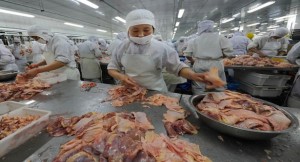
Yet again another food scandal is among us as the U.S. Department of Agriculture recently agreed to allow four chicken processing plants in China to raise and slaughter their chickens in the U.S., export them to China for processing, and them ship them back to the U.S. These chickens will then be sold on every grocery store shelf in the United States with no country of origin labeling. What’s worse is that U.S. inspectors will not be on site at the processing plants in China before the processed chicken will be shipped to the U.S.  Again, chicken from China labeled “Made In America”?

Read more